


Lauren Sallan
Lauren Sallan is an evolutionary biologist and paleontologist whose research focuses on how biodiversity is structured across deep time. Her work treats macroevolution as a complex system shaped by ecological limits, extinction, and functional constraint, using the fossil record and living fishes to uncover general principles governing evolutionary pattern and persistence.
She earned her PhD in Integrative Biology from the University of Chicago in 2012. She then held a prestigious independent postdoctoral fellowship with the Michigan Society of Fellows, which included a faculty appointment in Ecology and Evolutionary Biology. She subsequently served as the Martin Meyerson Assistant Professor in Interdisciplinary Studies at the University of Pennsylvania before joining the Okinawa Institute of Science and Technology to found the Macroevolution Unit in 2022.
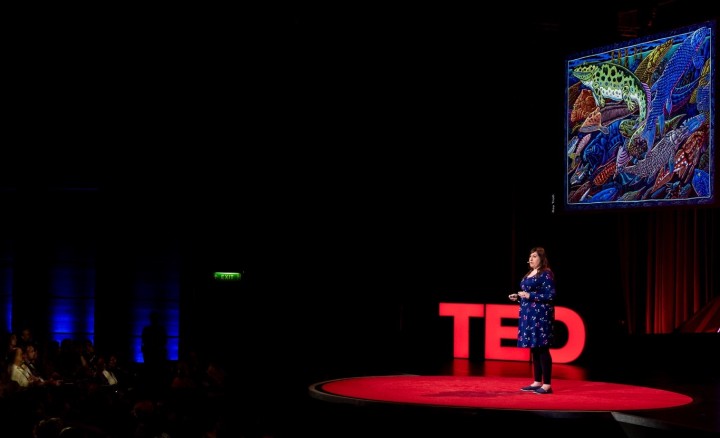
Dr. Sallan received the Stensio Award for early-career paleoichthyology in 2015 and the University of Chicago Biological Science Division Distinguished Service Award for Early Achievement in 2018. In 2019, she received a CAREER Award from the U.S. National Science Foundation and became a Senior Fellow of TED. She is a two-time speaker at TED, and her talks on fish evolution, mass extinction, and paleontology have been viewed by millions worldwide.
My research path has been shaped by following big questions across fossils, living systems, and theory - to understand how vertebrate diversity emerges, persists, and transforms through time.
⸻
Research Journey
My research has always centered on two questions: what actually happened in evolutionary history, and why?
I began with the fossil record because it provides natural experiments unavailable in living systems—mass extinctions, adaptive radiations, major evolutionary transitions, and repeated origins of unusual forms. I quickly found that many apparently settled explanations could not actually be distinguished from alternatives because the necessary primary evidence had never been assembled.
Much of my work therefore begins by building or reconstructing that evidence: fossil occurrences, morphological traits, ontogenetic series, environmental context, taxonomy, or comparative datasets. At vertebrate and deep-time scales, these resources may require years of assembly and reconciliation before the underlying evolutionary question can be tested.
Across those projects, several recurring mismatches became clear. Variation is not the same thing as realized form. Survival is not the same thing as radiation. Local ecological advantage does not necessarily produce long-term evolutionary success. And extensive taxonomic turnover can occur without expanding the functional space occupied by organisms.
These observations led me increasingly toward causal and mechanistic approaches. Fossils show what happened over deep time; development constrains which forms can be generated; biomechanics tests which can function; ecology and geography determine which are filtered or dispersed; phylogenetics reveals lineage fate; and generative models ask whether a proposed mechanism can actually reproduce the observed pattern.
At OIST, I have been able to bring these approaches together within one research program. The resulting Diversity–Reset Framework is an emerging synthesis for asking when processes observed at one scale persist, repeat, propagate, or sort strongly enough to become macroevolutionary structure - and when disruption changes those relationships.
The Macroevolution Unit now combines paleobiology, systematics, biomechanics, genomics, field ecology, developmental and comparative data, and theory around four linked questions: how disruption changes evolution; why some lineages radiate while others persist; when ecological processes scale into macroevolution; and why evolutionary forms recur or remain unrealized.
My research path has therefore been less a progression from one organism or method to another than a continued attempt to follow the evidence required to explain large-scale evolutionary patterns.

Research Unit