



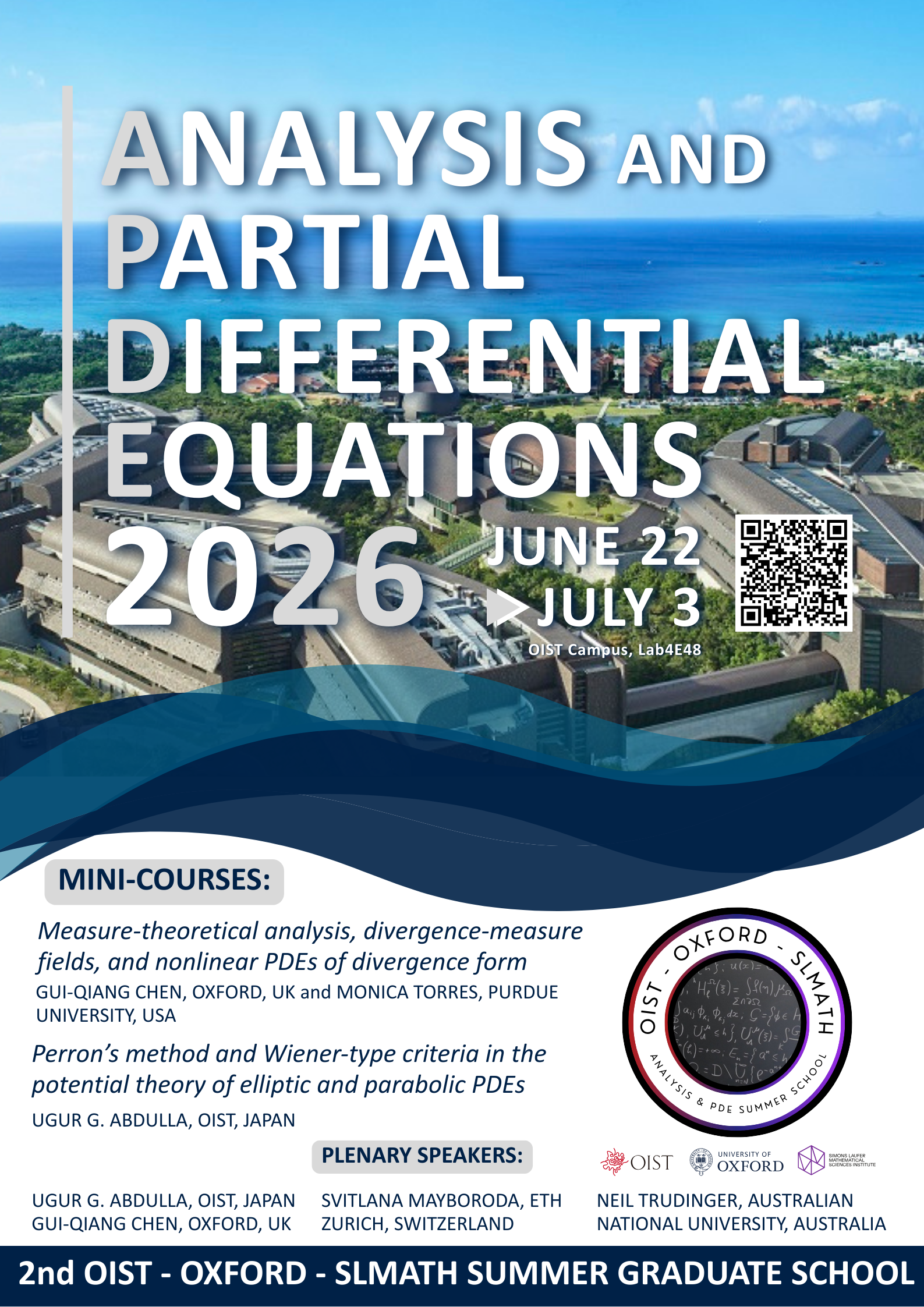
The 2nd OIST-Oxford-SLMath Summer Graduate School on Analysis of Partial Differential Equations will be held on June 22 (Monday) - July 3 (Friday) 2026, at OIST (Okinawa, Japan).
Organizing committee:
- Prof. Ugur G. Abdulla, Professor and Head of the Analysis & PDE Unit, Okinawa Institute of Science and Technology (OIST), Okinawa, Japan
- Prof. Gui-Qiang G. Chen, Statutory Professor in the Analysis of PDEs, Director of the Oxford Centre for Nonlinear PDEs (OxPDE), University of Oxford, United Kingdom
Lecturers:
- Prof. Ugur G. Abdulla, Professor and Head of the Analysis & PDE Unit, Okinawa Institute of Science and Technology (OIST), Okinawa, Japan
- Prof. Gui-Qiang G. Chen, Statutory Professor in the Analysis of PDEs, Director of the Oxford Centre for Nonlinear PDEs (OxPDE), University of Oxford, United Kingdom
- Prof. Monica Torres, Professor of Mathematics, Purdue University, USA
Plenary Lecturers:
- Prof. Ugur G. Abdulla, Professor and Head of the Analysis & PDE Unit, Okinawa Institute of Science and Technology (OIST), Okinawa, Japan
- Prof. Gui-Qiang G. Chen, Statutory Professor in the Analysis of PDEs, Director of the Oxford Centre for Nonlinear PDEs (OxPDE), University of Oxford, Oxford, United Kingdom
- Prof. Monica Torres, Professor of Mathematics, Purdue University, USA
Teaching Assistants:
- Dr. Daniel Tietz, Postdoctoral Scholar, Analysis & PDE Unit, OIST
- Dr. Denis Brazke, Postdoctoral Scholar, Analysis & PDE Unit, OIST
- Dr. Ian Miller, Postdoctoral Scholar, Analysis & PDE Unit, OIST
- Dr. Michael Albert, Postdoctoral Scholar, Analysis & PDE Unit, OIST
Scientific Description:
The SGS will offer two mini-courses during the two-week-long school:
- Course I: Measure-theoretical analysis, divergence-measure fields, and nonlinear PDEs of divergence form (Gui-Qiang G. Chen & Monica Torres)
In this course, we will present some recent developments in the theory of divergence-measure fields via measure-theoretical analysis and its applications to the analysis of nonlinear PDEs of conservative form – nonlinear conservation laws. We plan to start with an introduction to measure theory, BV functions, and a set of finite perimeter, and then present the theory of divergence-measure fields in L∞, Lp, and the space of Radon measures, respectively. With these, we will discuss applications of the theory of divergence-measure fields in several fundamental research directions, including the mathematical formulation of the balance law and derivation of systems of balance laws via the Cauchy fluxes, and the analysis of entropy solutions of nonlinear conservation laws (especially, nonlinear hyperbolic conservation laws), among others. Some further developments, open problems, and current trends on the research topics will also be addressed.
References
- Chen, G.-Q. and Torres, M. Lecture Notes (to be available for the summer school).
- Chen, G.-Q. and Torres, M. (2021): Divergence-Measure Fields: Gauss-Green Formulas and Normal Traces. Notices Amer. Math. Soc. 68 (2021), no. 8, 1282–1290.
- Chen, G.-Q. and Frid, H. (1999): Divergence-measure fields and hyperbolic conservation laws. Arch. Ration. Mech. Anal. 147(2): 89 – 118.
- Chen, G.-Q., Torres, M., and Ziemer, W. P. (2009): Gauss-Green theorem for weakly differentiable vector fields, sets of finite perimeter, and balance laws. Comm. Pure Appl. Math. 62(2): 242 – 304.
- Chen, G.-Q., Comi, G. E., Torres, M. (2019): Cauchy fluxes and Gauss-Green formulas for divergence-measure fields over general open sets. Arch. Ration. Mech. Anal. 233: 87–166.
- Dafermos, C. M. (2016): Hyperbolic Conservation Laws in Continuum Physics, 4th Ed., Grundlehren der Mathematischen Wissenschaften [Fundamental Principles of Mathematical Sciences], 325, Springer-Verlag: Berlin, 2016.
- Evans, L. C. and Gariepy, R. F. (1992): Measure Theory and Fine Properties of Functions. Studies in Advanced Mathematics. CRC Press: Boca Raton, FL, 1992.
- Federer, H.: Geometric Measure Theory. Springer-Verlag New York Inc.: New York, 1969.
Additional References:
- L. Ambrosio, N. Fusco, and D. Pallara (2000): Functions of Bounded Variation and Free Discontinuity Problems. Oxford Mathematical Monographs. The Clarendon Press, Oxford University Press: New York.
- Anzellotti, G. (1984): Pairings between measures and bounded functions and compensated compactness. Ann. Mat. Pura Appl. (4), 135: 293–318.
- Chen, G.-Q. and Frid, H. (2003): Extended divergence-measure fields and the Euler equations for gas dynamics. Commun. Math. Phys. 236: 251–280.
- Chen, G.-Q. and M. Torres, M. (2005): Divergence-measure fields, sets of finite perimeter, and conservation laws. Arch. Ration. Mech. Anal. 175: 245–267.
- Maz'ya, V. G. (2011): Sobolev Spaces with Applications to Elliptic Partial Differential Equations. Springer-Verlag: Berlin-Heidelberg.
- Pfeffer, W. F. (2012): The Divergence Theorem and Sets of Finite Perimeter, Chapman & Hall/CRC: Boca Raton, FL.
- Course II: Perron’s method and Wiener-type criteria in the potential theory of elliptic and parabolic PDEs (Ugur Abdulla )
Norbert Wiener's celebrated result on the boundary regularity of harmonic functions is one of the most beautiful and delicate results in XX-century mathematics. It has shaped the boundary regularity theory for elliptic and parabolic PDEs and has become a central result in the development of potential theory at the intersection of functional analysis, PDE, and measure theory. In this course, we will present some recent developments precisely characterizing the regularity of the point at ∞ for second-order elliptic and parabolic PDEs and broadly extending the role of the Wiener test in classical analysis. We preface the description of the course with a citation from a classical paper by Wiener: the Dirichlet Problem (DP) divides itself into two parts, the first of which is the determination of the harmonic function corresponding to certain boundary conditions, while the second is the investigation of the behavior of this function in the neighborhood of the boundary. In the first week of the course, we focus on proving the existence of the solution to the DP for the Laplace equation, and its parabolic counterpart for the heat/diffusion equation. Solvability, in some generalized sense, of the Dirichlet problem in an arbitrary open set with prescribed data on its topological boundary is realized within the class of resolutive boundary functions, identified by Perron's method, and its Wiener and Brelot refinements. Such a method is referred to as the PWB method, and the corresponding solutions are the PWB solutions. In the second week of the course, our focus will be on the boundary regularity of PWB solutions. The regularity of a boundary point is a problem of local nature, and it depends on the measure-geometric properties of the boundary in the neighborhood of the boundary point and the differential operator. After introducing the concept of Newtonian capacity, we discuss Wiener’s celebrated criterion, which expresses the boundary regularity in terms of the divergence of the Wiener integral with the integrand being a capacity of the exterior set in the neighborhood of the boundary point. The high point of the course is the new concept of regularity or irregularity of the point at ∞ defined according as to the harmonic (or parabolic) measure of ∞ is null or positive, and discussion of the proof of the new Wiener criterion for the regularity of ∞. The Wiener test at ∞ arises as a global characterization of uniqueness in boundary value problems for arbitrary unbounded open sets. From a topological point of view, the Wiener test at ∞ arises as a thinness criterion at ∞ in fine topology. In a probabilistic context, the Wiener test at ∞ characterizes asymptotic laws for the characteristic Markov processes whose generator is the given differential operator. The counterpart of the new Wiener test at a finite boundary point leads to uniqueness in the Dirichlet problem for a class of unbounded functions growing at a certain rate near the boundary point, a criterion for the removability of singularities and/or for unique continuation at the finite boundary point.
Participants: The school will be well-suited for an audience of graduate students with a wide range of abilities and knowledge. Both courses are designed in a way that the first week’s material mostly overlaps with the material taught in the standard graduate courses on Analysis and PDEs. Therefore, even first-year graduate students with solid undergraduate math backgrounds will have the potential for a comfortable and engaging start. Both courses will offer a tour de force for the transition from standard material to cutting-edge discoveries in the frontline of the field of PDEs. The structure of the courses will aim to create an active learning environment through a combination of classical and flipped classroom teaching. Every working day, each course will present a classical-style lecture given by the professor, followed by an active learning session. The goal of the second lecture is twofold: first, to sharpen the comprehension of the material of the given lecture, and second, to prepare students for the forthcoming lecture. Both professors and assistants will be involved in active learning sessions to help students. Starting from day 2, active learning sessions will include student presentations of the assignments given in the previous day’s lecture. To address the variance of academic backgrounds, students will be divided into groups, each group including students with varying backgrounds. Each group will have at least one presentation during the course, which will include the participation of all group members. In order to make active learning sessions more effective, an online discussion forum will be created, and students will be encouraged to post their questions and comments following every lecture. This discussion forum will define the major discussion topics of the following active learning sessions.
References
- U.G. Abdulla, Wiener’s Criterion at ∞ for the Heat Equation, Advances in Differential Equations, 13(5-6), (2008), 457-488.
- U.G. Abdulla, Wiener’s Criterion for the Unique Solvability of the Dirichlet Problem in Arbitrary Open Sets with Non-Compact Boundaries, Nonlinear Analysis, 67(2), (2007), 563-578.
- U.G. Abdulla, Regularity of ∞ for Elliptic Equations with Measurable Coefficients and Its Consequences, Discrete and Continuous Dynamical Systems - Series A (DCDS-A), 32, 10(2012), 3379-3397.
- U.G. Abdulla, Removability of the Logarithmic Singularity for the Elliptic PDEs with Measurable Coefficients and its Consequences, Calculus of Variations and Partial Differential Equations, 57, (6), (2018), 57-157.
- U.G. Abdulla, First Boundary Value Problem for the Diffusion Equation. I. Iterated Logarithm Test for the Boundary Regularity and Solvability, SIAM J. Math. Anal., 34(6), (2003), 1422–1434.
- U.G. Abdulla, Well-posedness of the Dirichlet Problem for the Nonlinear Diffusion Equation in Non-smooth Domains, Trans. Amer. Math. Soc., 357(1), (2005), 247–265.
- U.G. Abdulla, On the Dirichlet problem for the nonlinear diffusion equation in non-smooth domains, J. Math. Anal. Appl., 246, 2, 2001, 384-403
- D.H. Armitage and S.J. Gardiner, Classical Potential Theory, Springer Monographs in Mathematics, Springer, 2001.
- H. Bauer, Harmonische Raume und ihre Potentialtheorie, Lecture Notes in mathematics, Springer, 1966.
- M.Brelot, Lectures on Potential Theory, Tata Institute of Fundamental Research, Bombay, 1967.
- J.L. Doob, Classical Potential Theory and its Probabilistic Counterpart, Springer, 1984.
- L.C. Evans and R.F. Gariepy, Wiener’s criterion for the heat equation, Arch. Ration. Mech. Anal., 78, 1982, 293-314.
- L.C. Evans, Partial Differential Equations, AMS, 2nd edition, 2010.
- L.L. Helms, Potential Theory, Universitext, Springer, 2009.
- E. Lanconelli, Sul problema di Dirichlet per l’equazione del cslore, Ann. Math. Pura Appl., 97, 1973, 83-114.
- I.G. Petrowsky, Zur Ersten Randwertaufgabe der Warmeleitungsgleichung, Composito Math., 1, 1935, 383-419.
- N. A. Watson, Introduction to Heat Potential Theory, Mathematical Surveys and Monographs, vol. 182, Amer. Math. Soc., Providence RI, 2012.
- N. Wiener, Certain notions in potential theory, J. Math. Phys., 3, 1924, 24-51.
- N. Wiener, The Dirichlet problem, J. Math. Phys., 3, 1924, 127-146.
Lesson Plan/Syllabus: The daily schedule of the SGS was as follows:
Monday, June 22
- 9:00-10:15 Professor Ugur G. Abdulla, Perron's Method and Wiener-type Criteria in the Potential Theory of Elliptic and Parabolic PDEs. Lecture 1: Harmonic Functions - the mathematical representation of physical quantities in equilibrium
Zoom Recording Camera Recording - 10:30-11:45 Professor Ugur G. Abdulla, Perron's Method and Wiener-type Criteria in the Potential Theory of Elliptic and Parabolic PDEs. Lecture 2 (Active Learning Session): Mean value formulas, maximum/minimum principle for smooth sub-/superharmonic functions.
Zoom Recording Camera Recording - 12:00-13:00 Lunch
- 13:00-14:15 Course I - Lecture 1, Gui-Qiang Chen
- 14:15-14:45 Tea / Coffee Break
- 14:45- 16:00 Course I - Lecture 2 (Active Learning Session), Gui-Qiang Chen
Tuesday, June 23
- 9:00-10:15 Professor Ugur G. Abdulla, Perron's Method and Wiener-type Criteria in the Potential Theory of Elliptic and Parabolic PDEs. Lecture 3: Green's function and the representation formula, Poisson kernel.
Zoom Recording Camera Recording - 10:30-11:45 Professor Ugur G. Abdulla, Perron's Method and Wiener-type Criteria in the Potential Theory of Elliptic and Parabolic PDEs. Lecture 4 (Active Learning Session): Properties of the Poisson integral with a Lebesgue-integrable boundary function.
Zoom Recording Camera Recording - 12:00-13:00 Lunch
- 13:00-14:15 Course I - Lecture 3, Monica Torres
- 14:15-14:45 Tea / Coffee Break
- 14:45-16:00 Course I - Lecture 4 (Active Learning Session), Monica Torres
Wednesday, June 24
- 9:00-10:15 Professor Ugur G. Abdulla, Perron's Method and Wiener-type Criteria in the Potential Theory of Elliptic and Parabolic PDEs. Lecture 5: Riesz-Herglotz Theorem
Zoom Recording Camera Recording - 10:30-11:45 Professor Ugur G. Abdulla, Perron's Method and Wiener-type Criteria in the Potential Theory of Elliptic and Parabolic PDEs. Lecture 6 (Active Learning Session): Convergence of harmonic functions, Harnack inequality, derivative estimates.
Zoom Recording Camera Recording - 12:00-13:00 Lunch
- 13:00- 14:00 Plenary Lecture: Gui-Qiang Chen, Multidimensional Riemann Problems and Hyperbolic Conservation Laws
- 14:00-14:30 Tea / Coffee Break
- 14:30-15:45 Course I - Lecture 5, Monica Torres
- 16:00-17:00 Course I - Lecture 6 (Active Learning Session), Monica Torres
Thursday, June 25
- 9:00-10:15 Professor Ugur G. Abdulla, Perron's Method and Wiener-type Criteria in the Potential Theory of Elliptic and Parabolic PDEs. Lecture 7: Superharmonic functions, local integrability and a.e. finiteness, minimum principle.
Zoom Recording Camera Recording - 10:30-11:45 Professor Ugur G. Abdulla, Perron's Method and Wiener-type Criteria in the Potential Theory of Elliptic and Parabolic PDEs. Lecture 8 (Active Learning Session): Balayage of superharmonic functions, lifting/lowering operation.
Zoom Recording Camera Recording - 12:00-13:00 Lunch
- 13:00-14:15 Course I - Lecture 7, Monica Torres
- 14:15-14:45 Tea / Coffee Break
- 14:45-16:00 Course I - Lecture 8 (Active Learning Session), Monica Torres
Friday, June 26
*Due to Typhoon 7 (Mekkhala), Friday, June 26's classes were moved to Monday, June 29
Saturday, June 27
- Field trip to Naha, Okinawa World
Sunday, June 28
- Free day
Monday, June 29
- 9:00-10:15 Course I - Lecture 9, Monica Torres
- 10:30-11:45 Course I - Lecture 10 (Active Learning Session), Monica Torres
- 12:00-13:00 Lunch
- 13:00-14:00 Plenary Lecture: Monica Torres
- 14:00-14:30 Tea / Coffee Break
- 14:30-15:45 Professor Ugur G. Abdulla, Perron's Method and Wiener-type Criteria in the Potential Theory of Elliptic and Parabolic PDEs. Lecture 9: Perron's method for the Dirichlet problem.
Zoom Recording Camera Recording - 16:00-17:00 Professor Ugur G. Abdulla, Perron's Method and Wiener-type Criteria in the Potential Theory of Elliptic and Parabolic PDEs. Lecture 10 (Active Learning Session): Boundary regularity, barrier and weak barrier; exterior cone condition
Zoom Recording Camera Recording
Tuesday, June 30
- 9:00-10:15 Course I - Lecture 11, Monica Torres
- 10:30-11:45 Course I - Lecture 12 (Active Learning Session), Monica Torres
- 12:00- 13:00 Lunch
- 13:00-14:15
Professor Ugur G. Abdulla, Perron's Method and Wiener-type Criteria in the Potential Theory of Elliptic and Parabolic PDEs. Lecture 11: Bôligand's theorem, Lebesgue's spine, Newtonian potentials and Capacity.
Zoom Recording Camera Recording - 14:15-14:45 Tea / Coffee Break
- 14:45-16:00 Professor Ugur G. Abdulla, Perron's Method and Wiener-type Criteria in the Potential Theory of Elliptic and Parabolic PDEs. Lecture 12 (Active Learning Session): Existence and uniqueness of the capacitary measure for compact sets.
Zoom Recording Camera Recording
Wednesday, July 1
- 9:00-10:15 Professor Ugur G. Abdulla, Perron's Method and Wiener-type Criteria in the Potential Theory of Elliptic and Parabolic PDEs. Lecture 13: Wiener criterion for boundary regularity and uniqueness.
- Zoom Recording Camera Recording
- 10:30-11:45 Course I - Lecture 13, Monica Torres
- 12:00-13:00 Lunch
- 13:00-14:00 Plenary Lecture: Ugur G. Abdulla, Kolmogorov Problem and Wiener-type Criteria in Potential Theory
- 14:30-21:00 Field trip to Okinawa Aquarium and Banquet Dinner
Thursday, July 2
- 9:00-10:15 Course I - Lecture 14, Monica Torres
- 10:30-11:45 Course I -Lecture 15 (Active Learning Session), Monica Torres
- 12:00-13:00 Lunch
- 13:00-14:15 Professor Ugur G. Abdulla, Perron's Method and Wiener-type Criteria in the Potential Theory of Elliptic and Parabolic PDEs. Lecture 14: Proof of the Wiener criterion at ∞ for the unique solvability of the Dirichlet problem I.
Zoom Recording Camera Recording - 14:15-14:45 Tea / Coffee Break
- 14:45-16:00 Professor Ugur G. Abdulla, Perron's Method and Wiener-type Criteria in the Potential Theory of Elliptic and Parabolic PDEs. Lecture 15: Proof of the Wiener criterion at ∞ for the unique solvability of the Dirichlet problem II.
Zoom Recording Camera Recording
Friday, July 3
- 9:00-10:15 Professor Ugur G. Abdulla, Perron's Method and Wiener-type Criteria in the Potential Theory of Elliptic and Parabolic PDEs. Lecture 16: Proof of the Wiener criterion at \(\infty\) for the heat equation I
Zoom Recording Camera Recording - 10:30-11:45 Professor Ugur G. Abdulla, Perron's Method and Wiener-type Criteria in the Potential Theory of Elliptic and Parabolic PDEs. Lecture 17: Proof of the Wiener criterion at \(\infty\) for the heat equation II
Zoom Recording Camera Recording - 12:00-13:00 Lunch
- 13:30-16:30 Hiking trip to Ishikawa Mountain
- 18:00-20:00 BBQ at Shimanchu Club
Course 1 - Topics covered during the 1st week (Gui-Qiang G. Chen & Monica Torres):
- Measure Theory and BV Functions
Radon and Hausdorff measures, weak convergence of measures, convolutions, and representation of BV functions.
- Sets of Finite Perimeter
Basic properties of sets of finite perimeter, structure of sets of finite perimeter, almost one-sided smooth approximation of sets of finite perimeter, the approximation of sets of finite perimeter with respect to any measure that is absolutely continuous with respect to the co-dimension-one Hausdorff measure, and the main approximation results.
- Smooth One-Side Approximations to General Open Sets
Smooth one-sided approximations of the boundaries of general open Sets, smooth regular one-sided deformation of the boundaries of Lipschitz open sets.
4. Divergence-Measure Fields
Basic properties, product rules for divergence-measure fields, etc.
Course 1 - Topics covered during the 2nd week (Monica Torres):
5. Divergence-Measure Fields in L∞
The Gauss-Green formula over sets of finite perimeter, the divergence-measures of jump sets via the normal traces, consistency of the normal traces with the classical traces, extensions of divergence-measure fields, and the Gauss-Green formula over general open sets.
6. Divergence-Measure Fields in Lp and the Space of Radon Measures
Gauss-Green formula over Lipschitz domains, Gauss-Green formula over general open sets, etc.
7. Cauchy Flux, Balance Laws, and Entropy Solutions.
Cauchy fluxes and divergence-measure fields, mathematical formulation of the balance law and derivation of systems of balance laws, entropy solutions of hyperbolic conservation laws, applications of divergence-measure fields to conservation laws.
Course 2: Topics covered during the 1st week (Ugur Abdulla ):
5. Perron’s method for the Laplacian.
Harmonic functions, Gauss mean value formula, superharmonic functions, solution of the Dirichlet problem for Euclidean balls, the Poisson kernel, generalized solution of the Dirichlet problem in the sense of Perron-Wiener-Brelot, boundary behavior of the PWB solution, Bouligand’s theorem.
6. Perron’s method for the Heat operator.
The parabolic maximum principle, mean value theorem for caloric, super- and subcaloric functions, the existence of a basis of resolutive open sets for the Heat operator, convergence theorems and parabolic Harnack inequality, PWB solutions for the parabolic Dirichlet problem.
Course 2: Topics covered during the 2nd week (Ugur Abdulla):
7. Wiener criterion at ∞ for the Laplace equation.
Newtonian potentials, Newtonian capacity, minimization of energy functional in Hilbert space setting, Wiener criterion at finite boundary points, geometric tests for boundary regularity, harmonic measure, regularity of ∞, Wiener criterion for the regularity of ∞, fine topology, asymptotic laws for the Brownian motion
8. Wiener criterion at ∞ for the heat equation:
Thermal potentials, thermal capacity, geometric iterated logarithm test, parabolic measure, regularity of ∞, boundary Harnack inequality for the heat equation, proof of the Wiener criterion at ∞ for the heat equation, measure-theoretical, topological and probabilistic consequences of the Wiener test at ∞.
Prerequisites:
- Basic Measure Theory, Distribution Theory, Sobolev Spaces, Functional Analysis
- In the Graduate Textbook: Lawrence C. Evans, Partial Differential Equations, AMS, 2nd edition, 2010:
- Reviewing calculus facts outlined in Appendix C: Calculus
- Reviewing facts outlined in Appendices D and E: Fundational Analysis and Measure Theory
- Review Section 2.2. Laplace’s Equation; and Section 2.3. Heat Equation;
- Solve exercises 2-17 from Section 2.3 Problems.
- Review Section 2.4, Section 3, and Section 5
Math Subject Classification numbers:
Course 1: Primary: 28C05; 26B20; 28A05; 26B12; 35L65; 35L67, 35L50, 76A02, 35D30; 76L05; Secondary: 28A75; 28A25; 26B05; 26B30; 26B40; 35M30; 35B35; 35B40; 74J40.
Key Words: divergence-measure fields; PDE of divergence form; nonlinear conservation laws; hyperbolic conservation laws; sets of finite perimeter; BV functions; approximation; sets with Lipschitz boundary; open sets; Cauchy flux; balance laws; entropy solutions; foundation of continuum mechanics.
Course 2: Primary: 35J05; 35J25; 35K05; 35K20; 31C05; 31C15; 31C40; 31D05; 31A15; Secondary: 60J45; 60J65;54C50; 30C85; 32U20.
Key words: potential theory; elliptic and parabolic PDEs; Laplace equation; heat equation; Dirichlet problem; super- and subharmonic functions; Wiener criterion; boundary regularity; regularity (or irregularity) of ∞
; caloric function; super- and subcaloric functions; harmonic measure; parabolic measure; capacity; Newtonian potential; thermal capacity; thermal potential; Radon measure; fine topology; Brownian motion; Wiener processes;
Location description: The description of the facilities for the SGS is given in the following link
Title and Abstract of Plenary Lectures:
June 24 (Wed) 1:00 pm - 2:00 pm Prof. Gui-Qiang G. Chen (University of Oxford)
Title: Multidimensional Riemann Problems and Hyperbolic Conservation Laws
Abstract: In this talk, we first discuss the underlying connections between multidimensional Riemann problems—focusing on their global patterns and structures—and general entropy solutions of nonlinear hyperbolic systems of conservation laws. We then present recent progress in the rigorous analysis of several longstanding two-dimensional Riemann problems, both initial and lateral, involving transonic shock waves for the Euler equations of potential flow. In particular, we focus on the four-shock Riemann problem for the Euler equations for potential flow, as a representative example, to illustrate how these problems can be reformulated and solved as free boundary problems, with transonic shock waves serving as free boundaries for the corresponding nonlinear conservation laws of mixed elliptic–hyperbolic type. We further address several physically significant lateral Riemann problems, including Prandtl’s reflection problem and von Neumann’s shock reflection-diffraction problem. Moreover, we present different regularity properties of Riemann solutions to the compressible Euler equations for both potential and isentropic flows. We also discuss additional multidimensional Riemann problems and related shock-wave problems for nonlinear hyperbolic systems of conservation laws, if time permits.
June 29 (Mon) 1:00 pm - 2:00 pm Prof. Monica Torres (Purdue University)
Title: Curl-measure Fields and The Stokes' Theorem for Weakly Differentiable Vector Fields
Abstract: We introduce and analyze the class of curl-measure fields, consisting of p-integrable vector fields whose distributional curl is a vector-valued finite Radon measure. These spaces provide a unifying framework for the study of problems involving vorticity. We establish Stokes-type theorems for curl-measure fields by introducing Stokes functionals on good manifolds, characterized through the finiteness of manifold-adapted maximal operators, and by applying new trace theorems for curl-measure fields.
July 1 (Wed) 1:00 pm - 2:00 pm Prof. Ugur Abdulla(OIST)
Title: Kolmogorov Problem and Wiener-type Criteria in Potential Theory
Abstract: The central problem in the Analysis of PDEs is understanding the nature of singularities that arise in natural phenomena. This talk will present a full characterization of the fundamental boundary singularity, and equivalently, the unique solvability of the singular Dirichlet problem for the elliptic and parabolic PDEs. The results are threefold. We prove a new Wiener-type criterion for the geometric characterization of the removability of the fundamental singularity for arbitrary open sets in terms of the fine-topological thinness of the complementary set near the singularity point. In the special case when the surface of revolution forms the boundary of the open set near the singularity point, we establish a Kolmogorov-Petrovsky-type test to characterize the removability of the singularity and uniqueness. Finally, in the special case when a continuous graph locally represents the boundary of the open set, the minimal thinness criterion for the removability of the singularity is expressed in terms of the minimal regularity of the boundary manifold at the singularity point. From the probabilistic point of view, the criteria present an asymptotic law for conditional Brownian motion. In the topological context, the criteria present a full characterization of the neighborhood base of the boundary singularity point in the minimal-fine topology. In the more general framework, the talk will outline a program for the full characterization of the singularities formed by the elliptic and parabolic PDEs.
